Indoor Air Quality: Straight Answers
Florida air is warm, humid, and full of pollen half the year. Plenty of products promise to “purify” your air. Some work well, some help a little, and some are mostly marketing. Here’s an overview based on research from the EPA and ASHRAE, the engineering society that sets standards for heating and air conditioning. The sources are listed at the bottom of this page.
Start Here: The Right Air Filter
For dust, pollen, and pet dander, a good filter changed on schedule is usually the most effective and least expensive improvement. Filters that are too restrictive can strain your system, so choosing the right one matters. Ask us about filter options for your system.
Control the Humidity
In South Florida, humidity is the real enemy. It feeds mold, mildew, and dust mites, makes your home feel clammy, and can cause musty odors. A properly sized A/C removes moisture as it cools, but it doesn’t always keep up on its own.
Many newer thermostats can display indoor humidity, send alerts to your phone when you’re away, and run the A/C to help reach a humidity target you choose. Whole-home dehumidifiers are another option for homes that need extra help.
Where Should Your Humidity Be?
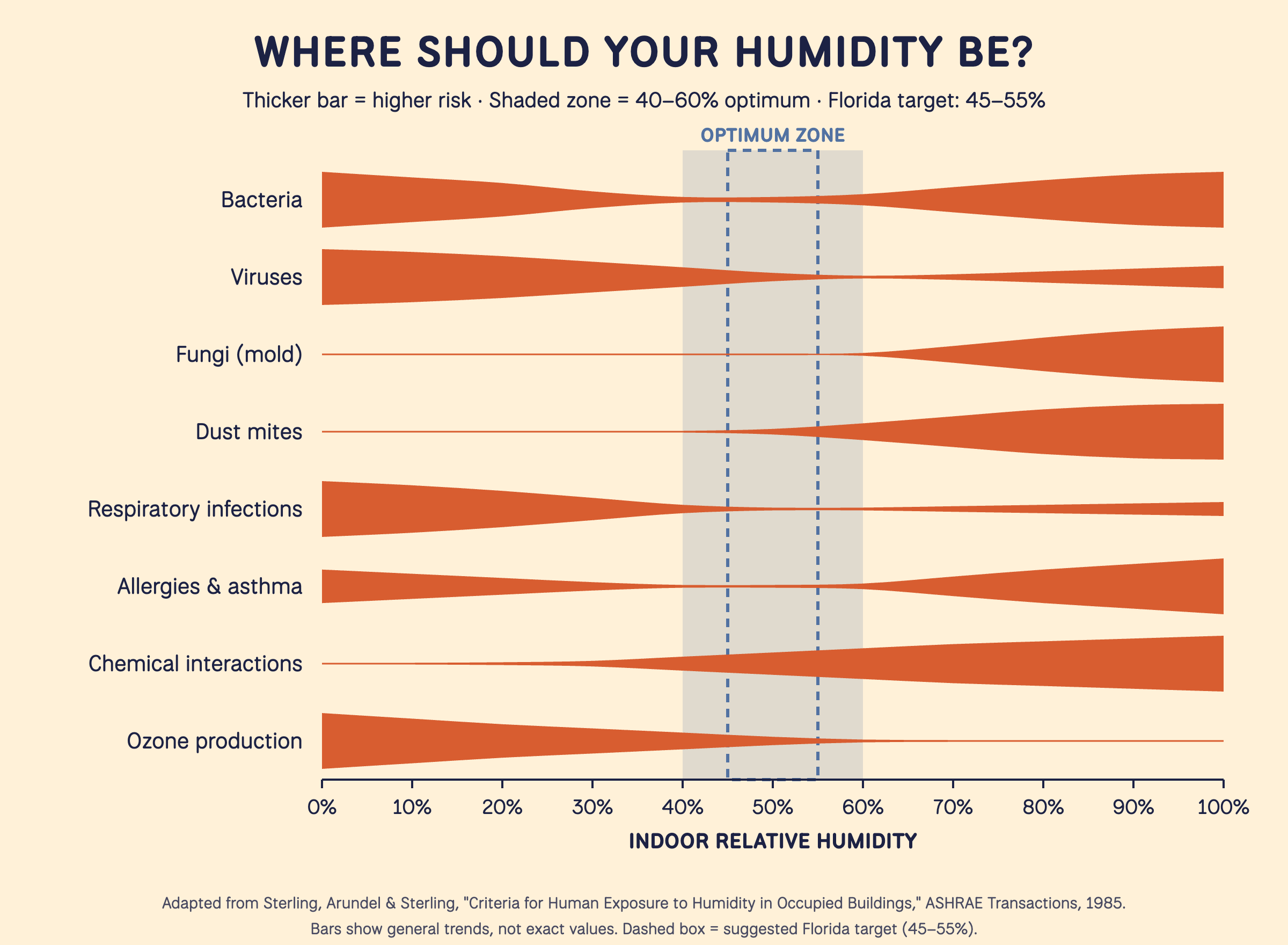
Research summarized by ASHRAE shows that many indoor health concerns get worse when air is too dry or too damp. Most are lowest in a middle zone of about 40–60% relative humidity. The EPA recommends keeping indoor humidity below 60%.
For most Florida homes, 45–55% is a good balance of comfort, health, and protection from mold.
Leaving for the season? Ask us about options to help keep your home dry while you’re away.
UV Lights: What They Really Do
Inside your air handler, the cooling coil and drain pan stay damp, and that’s where mold and slime like to grow. A coil-mounted UV-C light shines on those surfaces around the clock to help keep that growth from coming back.
What it’s good for: a cleaner coil, fewer musty odors, and a system that doesn’t have to work as hard. Research by the EPA and ASHRAE supports UV for keeping coils clean, including an ASHRAE-funded field study in Tampa.
What it’s not: a whole-house air purifier. Air moves past the light in a fraction of a second, which limits how much it can do for airborne germs. One study cited by the EPA found a 99% reduction in growth on HVAC surfaces, but only a 25–30% reduction in airborne bacteria.
Dual-lamp systems: On larger systems, a second lamp can reach parts of the coil a single lamp may miss, and some air handlers have room to space lamps along the airflow for a bit more exposure time. Not every system has the space, especially in condos, so it depends on your setup.
Good to know:
- UV lights work best on a clean coil.
- Lamps typically need replacing about once a year.
- The UV-C lights we offer are designed for coil treatment, not ozone production.
UV + Photocatalytic (UVPCO) Units
These combine a UV lamp with a coated catalyst surface that reacts with odors and some chemicals in the air. Manufacturers say they reduce odors, bacteria, and VOCs. Independent research shows results vary widely by product, and the EPA notes some units can create small amounts of byproducts. They can be an option for specific odor concerns.
Ionizers and Plasma Air Cleaners
These send charged particles into the air to help with odors and airborne particles. Research on them is still developing, and some designs produce ozone. If you’re considering one, ask us about the options we carry.
Duct Cleaning
Not every home needs duct cleaning. Dust on your vents is normal. If there’s real buildup, debris, or mold growth inside your ducts, cleaning can help, and we can take a look.
Our Approach
We explain what we find, walk you through your options, and help you choose what makes sense for your home and budget.
Questions about the air in your home? Call 561-298-4970 or ask during your next tune-up.
Sources
- U.S. EPA: Air Cleaners and Air Filters in the Home (opens in a new tab)
- U.S. EPA: Residential Air Cleaners: A Technical Summary (3rd ed.) (opens in a new tab)
- U.S. EPA: Mold and Moisture (opens in a new tab)
- ASHRAE: Filtration and Air Cleaning Position Document (2024) (opens in a new tab)
- ASHRAE research project RP-1738 (Penn State): UV coil study overview (opens in a new tab) · published paper (opens in a new tab)
- Sterling, Arundel & Sterling, “Criteria for Human Exposure to Humidity in Occupied Buildings,” ASHRAE Transactions, 1985: summary in the authors’ 1986 review (opens in a new tab)
Ready to be comfortable again?
Call us or send a request and we will get back to you.